Every bank has at least one of them.
A system running on infrastructure that predates the current CTO’s tenure. An application with no documentation, one person who truly understands it, and the quiet institutional terror that comes with the thought of that person leaving. A platform that works — mostly — but cannot be changed, cannot be integrated with anything modern, and cannot scale without significant engineering effort.
Legacy systems in banking are not just a technical problem. They are a strategic constraint. They slow down every digital initiative, create compliance risk as regulatory requirements evolve around them, and generate disproportionate maintenance costs that consume engineering capacity that should be focused on building for the future.
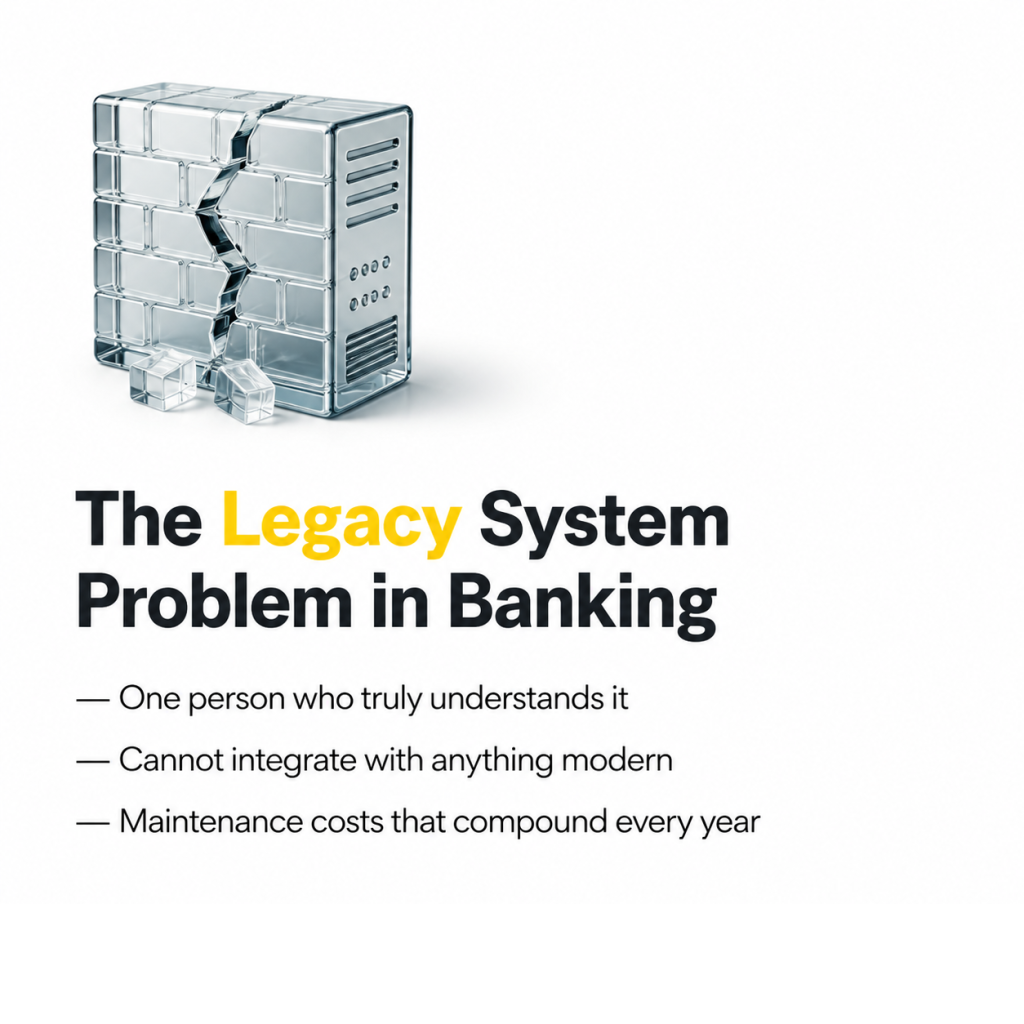
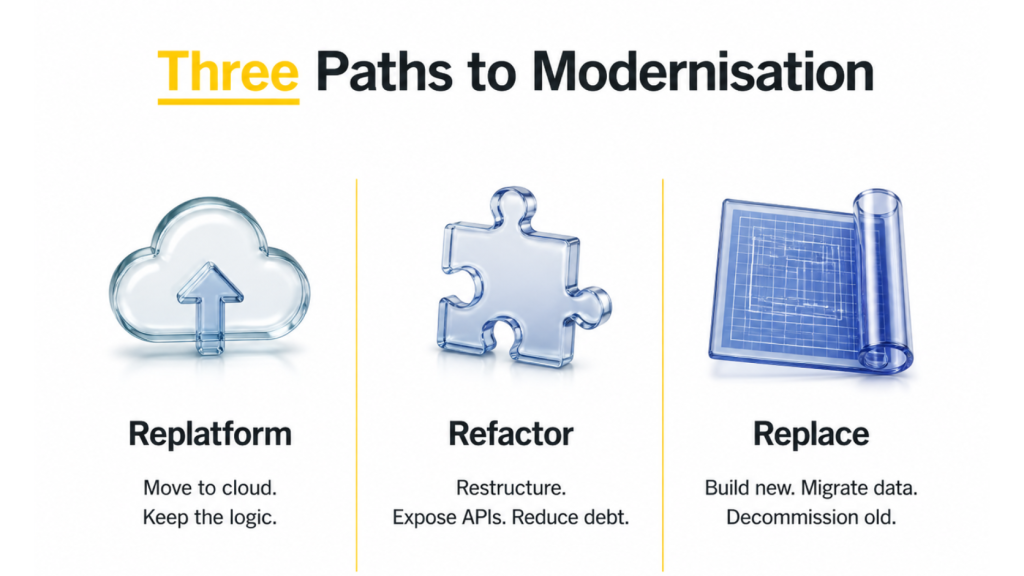
The Three Options — and When Each One Makes Sense
Option 1: Replatform (Lift and Modernise)
Move the application to a modern cloud infrastructure — Azure, in most cases for Microsoft-aligned financial institutions — without rewriting the application logic itself. Containerise workloads, modernise the hosting environment, add modern monitoring and security tooling, but keep the core business logic intact.
This is the right choice when: the application’s business logic is correct and well-understood, the primary problem is the infrastructure it runs on (aging hardware, on-premise data centre costs, inability to scale), and there is no strategic reason to change how the application works.
What you gain: cloud scalability, modern security controls, reduced infrastructure maintenance cost, and the ability to connect the application to modern APIs and data platforms. What you do not gain: a modern codebase, better performance of poorly-written logic, or simplified maintenance.
Option 2: Refactor or Re-architect
Keep most of the existing code but restructure it for modern deployment — breaking a monolithic application into services, introducing API layers that allow integration with other systems, improving performance bottlenecks.
This is the right choice when: the application has significant business value embedded in its logic, but its architecture prevents the integrations or scalability the business needs. Common in banking when a core system needs to expose APIs to a new CRM or customer portal without a full rebuild.
This approach requires the most careful planning and the deepest understanding of the existing codebase. A refactoring project that is not based on accurate understanding of what the existing code actually does (rather than what it was supposed to do) creates new problems faster than it resolves old ones.
Option 3: Replace
Build or buy a replacement system, migrate data and operations from the legacy platform, and decommission the old system when the new one is stable.
This is the right choice when: the business logic in the legacy system is genuinely incorrect or outdated, the technology is so old that it cannot be safely replatformed, the cost of maintaining the legacy system exceeds the cost of replacement, or regulatory requirements cannot be met on the current platform.
Full replacement is the most expensive and highest-risk option — but for some legacy systems, it is the only realistic path forward. The key is migrating in phases rather than attempting a big-bang cutover. Banking operations cannot be interrupted, and a well-designed phased migration allows the new system to prove itself in production while the legacy system remains the system of record until confidence is established.
The Assessment That Comes Before Any Decision
The most expensive mistake in legacy modernisation is choosing an approach before fully understanding what you are dealing with.
FiNASAL’s ADM (Application Development and Maintenance) services always begin with a legacy assessment — a structured technical and business review that produces:
- A complete inventory of the legacy application: modules, integrations, data volumes, user base, technology stack
- An honest assessment of code quality: test coverage, documentation status, technical debt level
- A dependency map: what other systems depend on this application, and how
- A regulatory review: what compliance obligations the application currently meets, and where gaps exist
- A business value assessment: what would break, and how severely, if this system were unavailable
Only after this assessment can an informed decision be made about which modernisation approach makes sense. Without it, every modernisation plan is built on assumptions — and assumptions about legacy banking systems are almost always wrong in ways that surface expensively mid-project.
Common Failure Patterns in Legacy Banking Modernisation
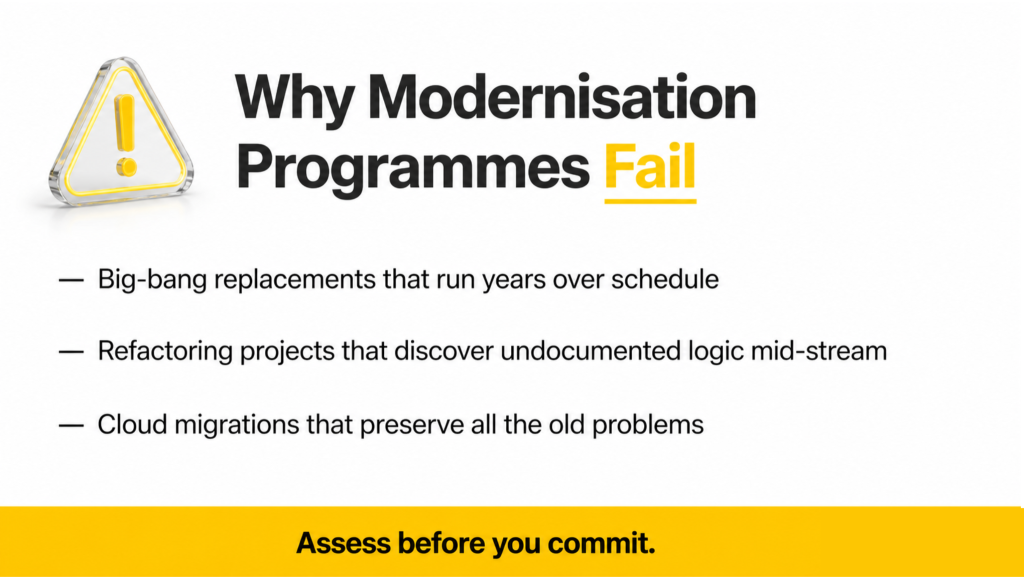
The big-bang replacement that runs three years over schedule. A bank decides to replace its entire core banking system in 18 months. Three years in, the legacy system is still live, the new system is partially deployed, and both environments need to be maintained simultaneously. This pattern is so common in banking that it has become a cliché — and it almost always traces back to inadequate assessment of the legacy environment before committing to a replacement scope.
The refactoring project that discovers undocumented logic mid-stream. A technical team starts refactoring a loan processing system and discovers, six months in, that several critical business rules are implemented in undocumented stored procedures that nobody on the current team understands. The only person who knows what they do left four years ago. The project stalls while the team attempts to reverse-engineer business rules from database code.
The cloud migration that preserves all the problems. A bank lifts a legacy application to Azure without addressing its underlying architecture problems. The application is now cloud-hosted but still monolithic, still difficult to integrate, and now also expensive to run in the cloud because it was not designed for cloud economics.
What Good Legacy Modernisation Actually Looks Like
The programmes that succeed share common characteristics.
They assess before they commit. Scope is defined based on evidence about the legacy system, not assumptions. The assessment reveals the real complexity, which shapes the realistic plan.
They modernise in phases. New capabilities are built and validated before legacy systems are decommissioned. Parallel running periods, with clear criteria for cutover, reduce the risk of irreversible decisions.
They invest in integration architecture early. Modern banking environments require applications to share data — between CRM, core banking, analytics, and regulatory reporting. Building clean API integration layers early, rather than creating point-to-point connections, makes the modernised environment easier to maintain and extend.
When FiNASAL delivered the Dynamics 365 CRM implementation for Leading Saudi Bank, the integration layer connecting the CRM to Saudi Bank core banking environment was designed using Azure API Management — creating a secure, auditable, maintainable integration that future systems can connect to without requiring bespoke integration work each time.
They use modern delivery practices throughout. Legacy modernisation projects delivered via waterfall methodology — where the entire replacement system is designed, built, and tested before anyone sees a working product — accumulate risk the same way legacy systems accumulate technical debt. FiNASAL delivers modernisation programmes through the FiNLean™ delivery model: working software demonstrated every two weeks, continuous feedback, and quality embedded in every sprint rather than tested at the end.
They address DevSecOps from the start. A modernised banking application that is deployed through the same manual, batched release process as the legacy system has gained cloud infrastructure but not delivery agility. FiNASAL’s DevOps practice is integrated into modernisation programmes from the start — so the new application goes live with a CI/CD pipeline, automated testing, and monitoring already in place.
They plan for post-go-live operations. What happens after go-live? Who owns the modernised application? How are incidents managed? How is ongoing enhancement delivered? Without a clear answer to these questions, modernisation programmes deliver a new system and then leave the client to figure out how to run it.
FiNASAL’s managed IT services model provides a natural continuation from implementation to ongoing operation — the same team that built the platform transitions into its ongoing management, maintaining continuity of knowledge.
The Question to Ask Before Starting
Before committing to any modernisation programme, ask this: “Do we have a complete, accurate picture of what the legacy system actually does — not what it was designed to do, but what it does today, including every undocumented behavior, every integration dependency, and every business rule embedded in the code?”
If the answer is anything less than confident yes, the first step is an assessment, not a migration.