
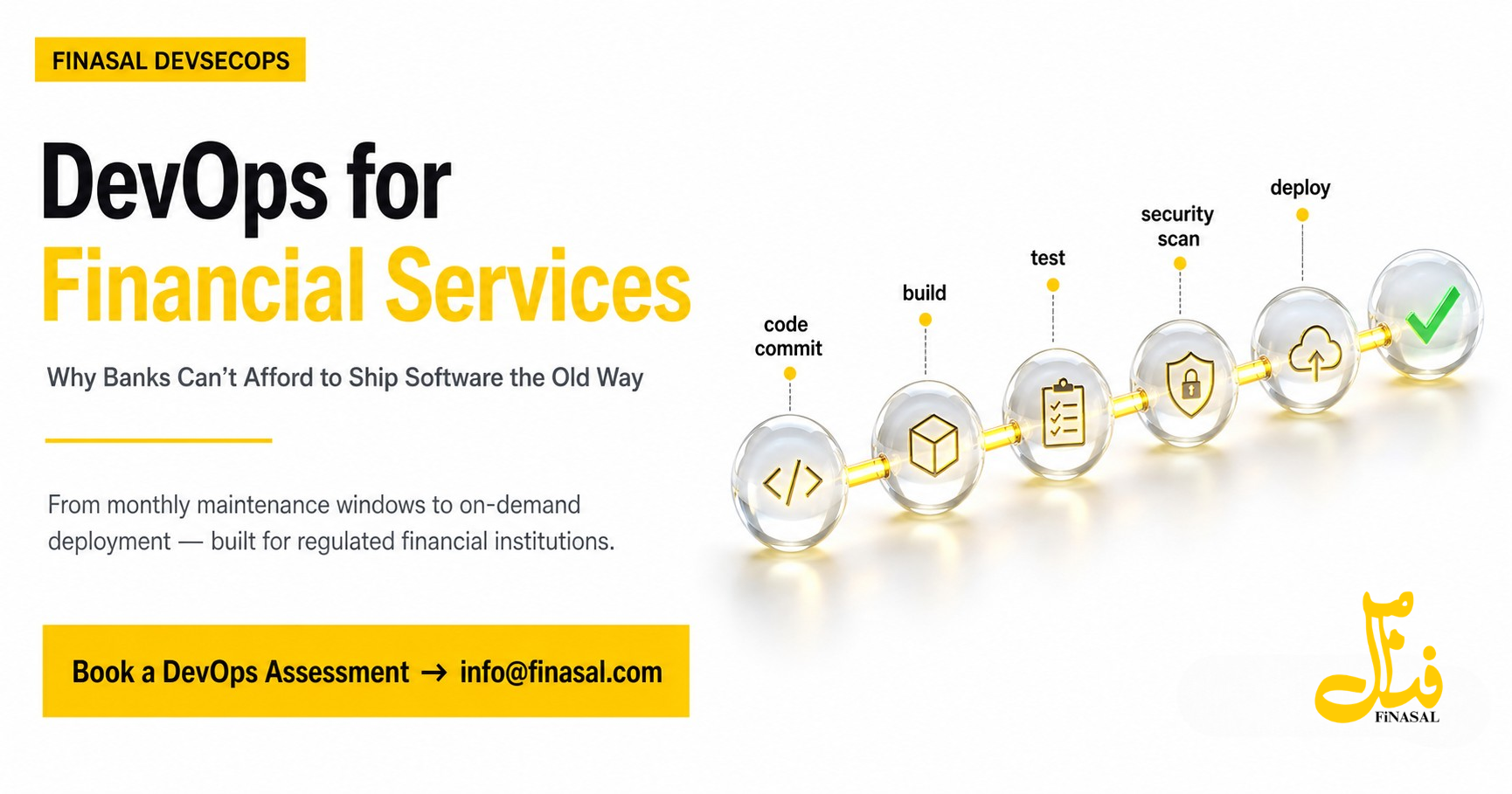
A bank in the GCC recently described their software release process to me like this: “We have a deployment window on the third Sunday of every month. The team works from 10pm to 4am. Half the time something breaks and we roll back. The other half, we spend the next week fixing what the deployment missed.”
Monthly releases. Night-time windows. Frequent rollbacks. This is not unusual — it is the norm at financial institutions that have not modernised their software delivery practices.
Meanwhile, their fintech competitors are shipping to production dozens of times a week, with automated testing catching issues before they reach users and automated rollback triggering within seconds if something goes wrong after deployment.
The gap between how traditional banks ship software and how modern technology organisations ship software is one of the most significant competitive disadvantages in financial services today. DevOps — and specifically DevSecOps — is how that gap gets closed.
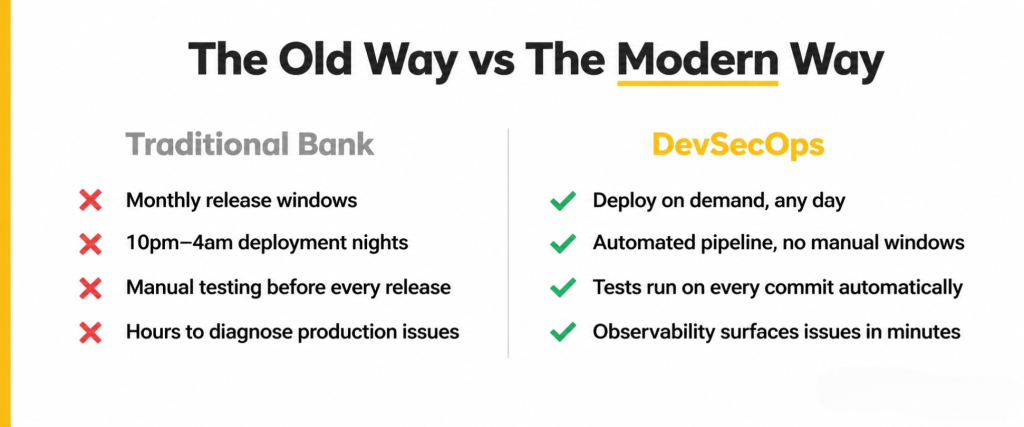
Figure 1. Old Way vs Modern Way
Why Software Delivery Is Broken at Most Banks
The root cause is almost always the same: delivery processes designed for a world where software releases were rare, expensive, and high-risk events. And in many cases, the delivery process is not the only thing that is outdated — the application being released is itself a legacy system that was never properly modernised. If that is the situation you are in, it is worth reading this first: Legacy Banking System Modernisation: When to Rebuild, Migrate, or Leave It Alone.
In that world, the safest approach was to batch up changes for months, test everything manually in a staging environment that barely resembled production, and then deploy everything at once in a carefully managed maintenance window.
The problem is that batching changes for months does not reduce risk — it concentrates it. When something goes wrong in a big-batch release (and something always goes wrong), diagnosing the root cause across hundreds of changes is exponentially harder than diagnosing it in a small, focused release.
Modern DevOps inverts this logic. Smaller, more frequent releases are actually safer than large infrequent ones — because each change is smaller, easier to test, easier to reason about, and easier to reverse.
What DevSecOps Means in a Banking Context
DevOps in financial services is not the same as DevOps at a software startup. Banks operate under regulatory obligations that require security, compliance, and audit controls built into every stage of the software delivery process — not bolted on at the end.
This is where DevSecOps becomes the right framing. Security and compliance are not a final review gate before release. They are embedded in every commit, every build, and every deployment.
In practice this means:
Static Application Security Testing (SAST) in the pipeline. Every code commit is automatically scanned for security vulnerabilities before it can merge. Developers see security feedback in their IDE or pull request, not six weeks later in a penetration test report.
Automated compliance checks. Regulatory control requirements — encryption standards, access control rules, logging requirements — are validated automatically as part of every build. This creates a documented audit trail of compliance validation for every release, not just for annual audits.
Infrastructure as Code (IaC). Server and cloud environment configuration is defined in code, version-controlled, and deployed through the same pipeline as application code. This eliminates configuration drift — the gradual divergence between environments that causes “it works on staging but not on production” failures.
Automated regression testing. A comprehensive automated test suite that runs on every build catches regressions before they reach any live environment. FiNASAL’s quality assurance practice is integrated directly into DevSecOps pipelines — ISTQB-certified engineers build and maintain the test suites that validate every release.
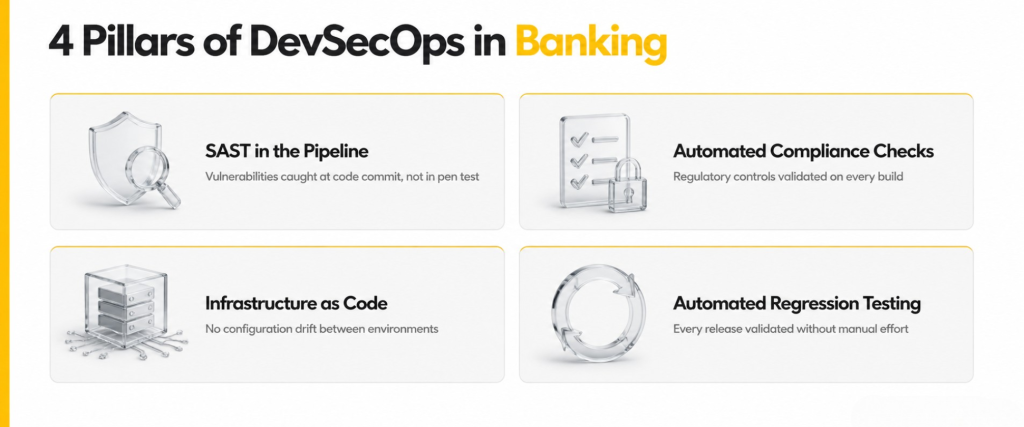
Figure 2. 4 Pillars of DevSecOps
The Specific Problems DevOps Solves for Banks
Long Release Cycles That Slow Down Feature Delivery
When your release cycle is monthly or quarterly, the business waits months for every improvement to the customer-facing application. Product managers pad their timelines because they know that missing the release window means waiting another month. Technical debt accumulates because “we’ll fix it next release” is a real option.
CI/CD pipelines change this dynamic. When you can deploy daily — or on demand — the constraint on delivery speed shifts from release mechanics to the quality of the code itself. That is a much healthier constraint to optimise against.
Manual Testing That Creates Bottlenecks and Misses Edge Cases
Manual testing at scale is slow, expensive, and unreliable. A team of QA engineers testing a large banking application manually before each release will miss edge cases, cannot run regression suites in parallel, and becomes the bottleneck that limits release frequency.
Automated testing — unit tests, integration tests, API tests, UI tests, performance tests — running in a CI pipeline catches issues faster, more consistently, and at a fraction of the cost of equivalent manual testing effort.
Production Issues That Take Hours to Diagnose
Without proper observability — structured logging, distributed tracing, application performance monitoring — production issues in banking systems can take hours or days to diagnose. During that time, operations staff are working blind, customer experience is degraded, and the risk of regulatory SLA breaches is rising.
A properly instrumented DevSecOps pipeline includes observability from Day 1: every service emits structured logs, every transaction has a trace ID, and dashboards surface anomalies in real time. When something goes wrong, the on-call engineer has the information they need within minutes, not hours.
This connects directly to FiNASAL’s managed IT services model — where 24/7 NOC and observability tooling operate as an extension of the DevSecOps pipeline, ensuring that production anomalies are detected and escalated before they become customer-facing incidents.
Security Vulnerabilities Found Late
Finding a security vulnerability in a penetration test four weeks before a planned release creates an impossible choice: delay the release (expensive) or ship with a known vulnerability (unacceptable). Finding the same vulnerability at code commit — before it is in any environment — is cheap and easy to fix.
Security shift-left is not just a best practice in banking. For institutions operating under SAMA, NCA ECC, or UAE PDPL frameworks, it is increasingly a regulatory expectation.
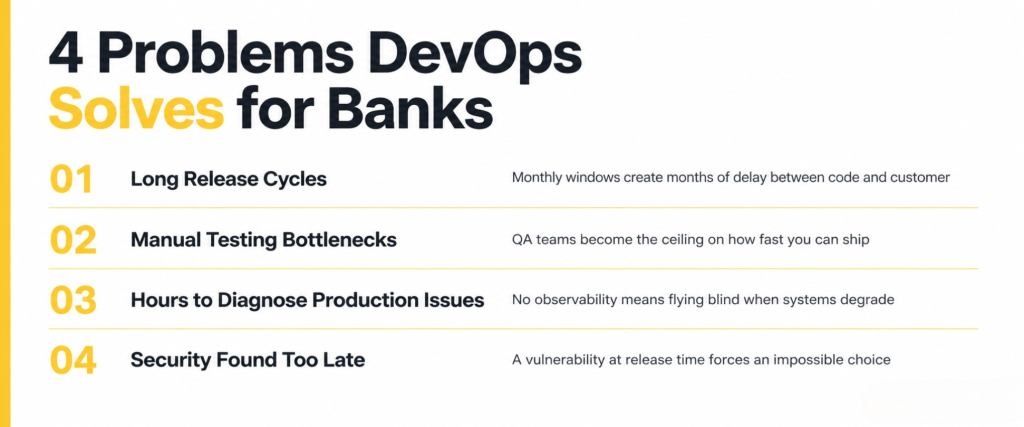
Figure 3. 4 Problems DevOps Solves
What a FiNASAL DevSecOps Engagement Looks Like
FiNASAL’s DevOps practice is built specifically for financial services organisations that need to modernise delivery without disrupting live operations.
The starting point is always an assessment: understanding the current state of your pipelines (or lack thereof), your test coverage, your deployment process, your infrastructure management, and your security practices. From that baseline, a phased modernisation roadmap is built.
Implementation is delivered through the FiNLean™ delivery model — which means tangible, working pipeline improvements are visible within the first sprint, not after a six-month waterfall build. Teams see automated tests running, security scans firing, and deployments completing without manual intervention in the first weeks of the engagement.
Typical outcomes for banking clients:
- Release frequency moves from monthly or quarterly to weekly or on-demand
- Production defect rates drop significantly as automated testing catches issues earlier
- Deployment lead time — from code commit to production — reduces from days or weeks to hours
- Security posture improves measurably as SAST and DAST findings surface and are resolved continuously rather than accumulating between audits
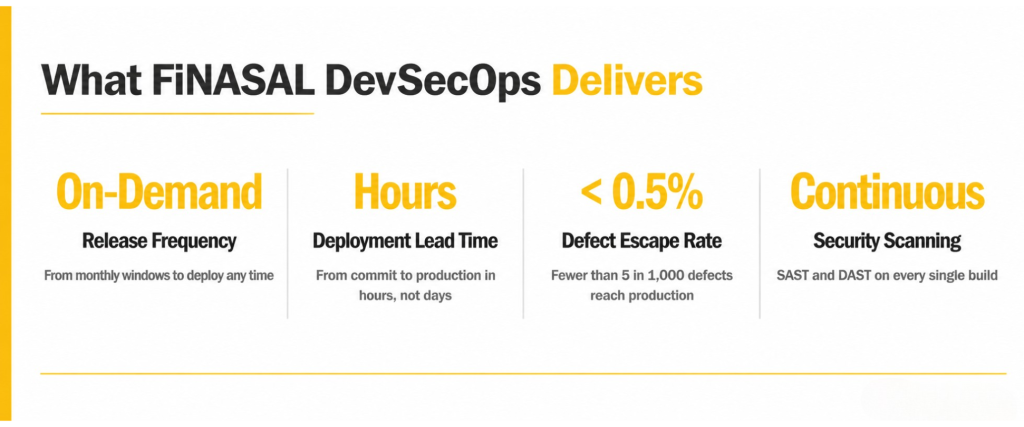
Figure 4. Outcomes Stats
The Right Question to Ask Your Team
Ask your software delivery team one question: “How long would it take us to deploy a single, tested, one-line configuration change to production right now?”
If the answer involves scheduling a change request, waiting for the next maintenance window, coordinating a manual deployment, and having someone stay late to monitor — your delivery process is the bottleneck.
That is the starting point for a DevSecOps conversation.
Contact FiNASAL: info@finasal.com
DevOps Services: www.finasal.com/services/devops
Figure 5. If deploying a change needs a maintenance window — delivery is the bottleneck.