
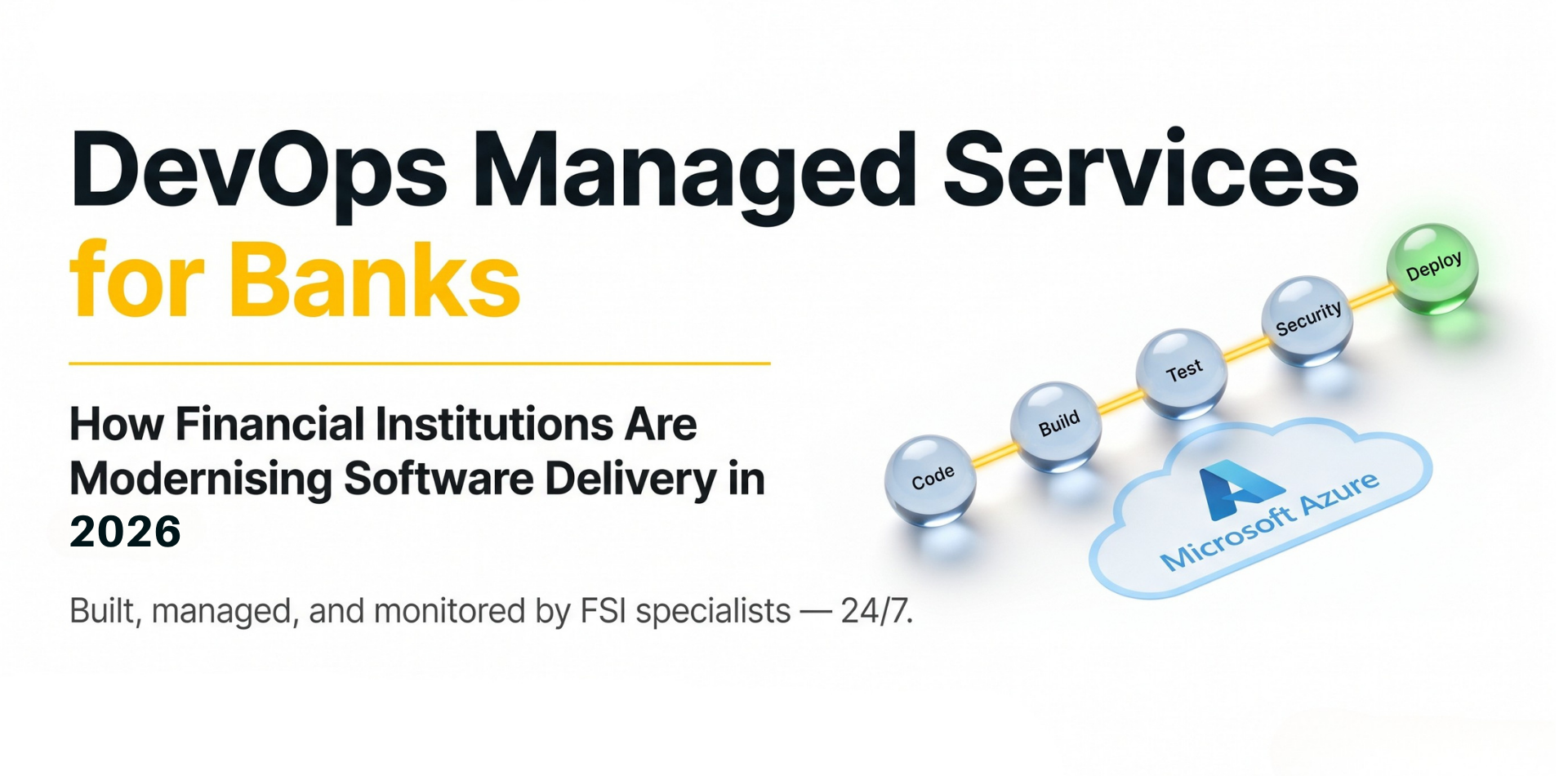
A bank in the GCC recently described their software release process like this: “We have a deployment window on the third Sunday of every month. The team works from 10pm to 4am. Half the time something breaks and we roll back. The other half, we spend the next week fixing what the deployment missed.”
Monthly releases. Night-time windows. Frequent rollbacks. This is not unusual — it is the norm at financial institutions that still manage software delivery in-house without a dedicated DevOps function.
Meanwhile, their fintech competitors are shipping to production dozens of times a week, with automated testing catching issues before they reach users and automated rollback triggering within seconds if something goes wrong.
The gap is real. And it is widening.
The answer for most banks is not hiring a DevOps team — it is partnering with a DevOps Managed Services provider that already has the pipeline expertise, the security tooling, the financial services domain knowledge, and the 24/7 operational capability in place.
What DevOps Managed Services Actually Means for a Bank
DevOps Managed Services is not a one-time implementation project. It is an ongoing operational partnership — where your provider owns, runs, and continuously improves your software delivery pipeline, the same way a managed IT provider owns your infrastructure.
In a banking context this means:
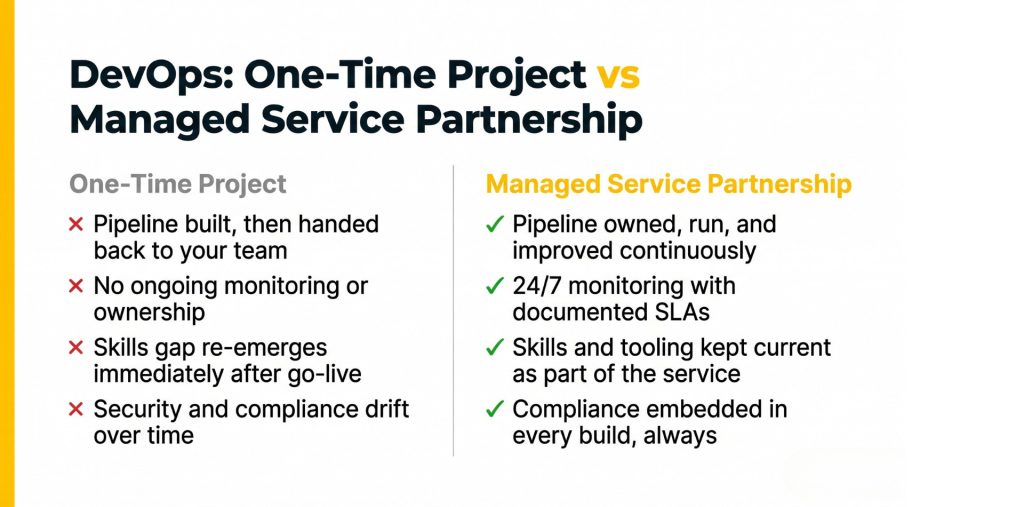
- Your CI/CD pipelines are built, maintained, and optimised by specialists — not left to internal teams to manage between other priorities
- Security scanning, compliance validation, and automated testing run on every build, continuously — not periodically
- Pipeline incidents are responded to 24/7, with documented SLAs
- Release frequency, pipeline performance, and defect rates are reported monthly as a managed service KPI — not tracked informally
FiNASAL’s DevOps Managed Services are built specifically for banks, fintechs, and microfinance institutions — combining 13+ years of financial services expertise with Azure DevOps tooling, SAMA and ZATCA compliance alignment, and a 24/7 support model that keeps your delivery pipeline running at peak performance.
Why Banks Cannot Manage This In-House Effectively
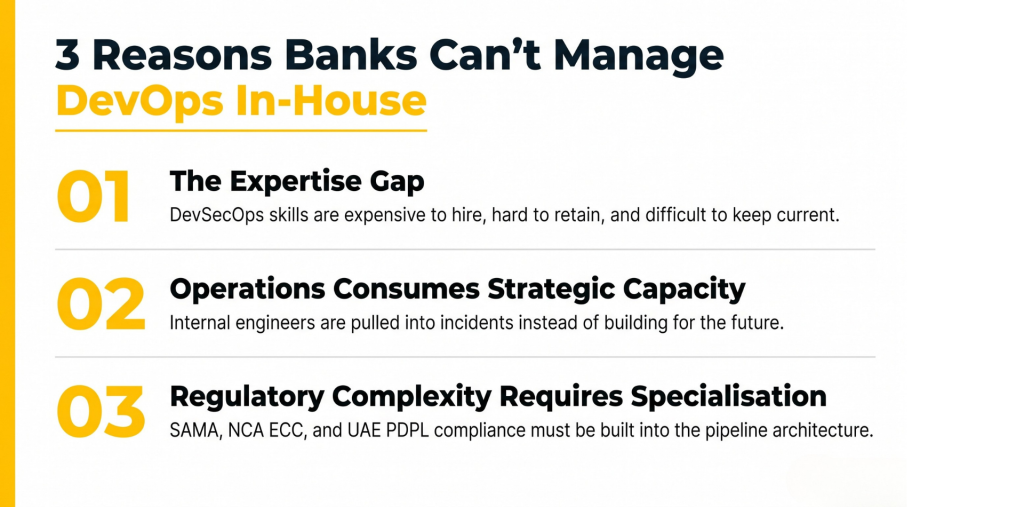
The Expertise Gap Is Significant
Building and maintaining a mature DevSecOps pipeline requires specialised skills that are expensive to hire, difficult to retain, and hard to keep current. Security tooling evolves. Azure DevOps releases new capabilities. Compliance requirements change.
A managed services model gives banks access to a team that lives and breathes this — keeping skills and tooling current as part of the service, not as an additional burden on an already stretched internal team.
Internal Teams Get Pulled Into Operations
Even banks with capable internal DevOps engineers find that day-to-day operations consume the capacity that should be going into pipeline improvement. Incident response, access management, environment issues, ad hoc requests — they crowd out the strategic work.
With DevOps as a managed service, the operational layer is owned by the provider. Your internal engineers focus on what only they can do — understanding the business, shaping the product roadmap, making architecture decisions.
The Regulatory Complexity Requires Specialisation
DevOps in financial services is not the same as DevOps at a software startup. Every pipeline that touches a banking application operates under regulatory obligations — SAMA controls, NCA ECC security requirements, UAE PDPL data handling rules, ZATCA compliance for Saudi institutions. Building compliance validation into a CI/CD pipeline requires someone who understands both the pipeline architecture and the regulatory framework. That combination is rare. And it is precisely what FiNASAL’s Azure DevOps Managed Services practice is built around.
What Is Included in FiNASAL’s DevOps Managed Services1
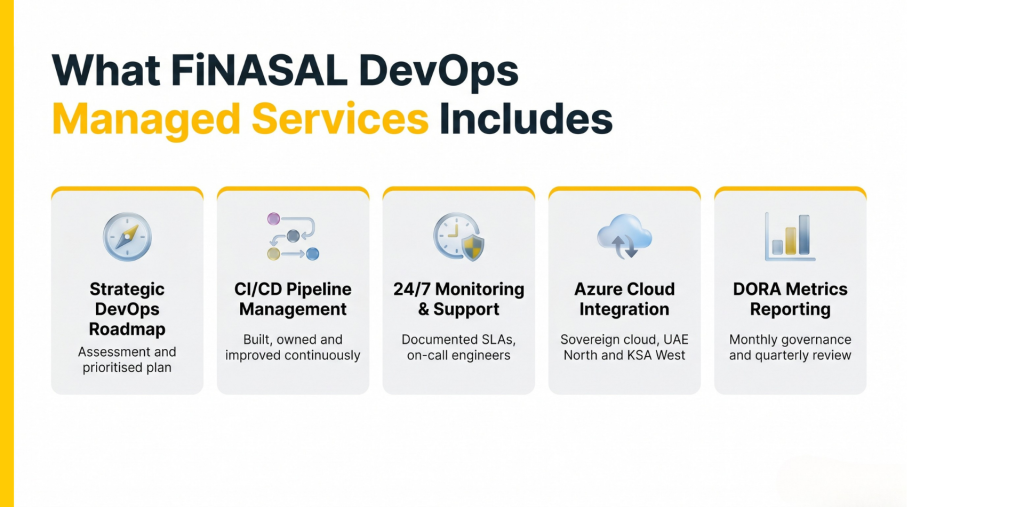
Strategic DevOps Roadmap and Assessment
Every engagement starts with a structured assessment of your current delivery state — pipeline maturity, test coverage, deployment frequency, security posture, and compliance gaps. From that baseline, a prioritised roadmap is built, aligned to your institution’s Vision 2030 or digital transformation goals.
This is not a generic maturity model. It is a financial-services-specific assessment that maps your current state against the standards that regulated institutions in the GCC are expected to meet.
CI/CD Pipeline Build and Ongoing Management
FiNASAL builds and owns your Azure DevOps CI/CD pipelines — automated build, test, security scan, and deployment workflows that run on every code commit. Once live, the pipeline is monitored, maintained, and continuously improved as part of the managed service.
This covers:
Automated build and release pipelines – for Dynamics 365 customisations, banking application deployments, and integration releases — with branch strategies, environment promotion controls, and rollback automation.
Security-first pipeline design — Static Application Security Testing (SAST) and Dynamic Application Security Testing (DAST) embedded in every pipeline stage. Vulnerabilities are caught at commit, not in a penetration test four weeks before a planned release.
Automated compliance checks — regulatory control requirements validated automatically on every build, creating a documented audit trail for SAMA, NCA ECC, and UAE PDPL examination.
Infrastructure as Code (IaC) — environment configuration version-controlled and deployed through the same pipeline as application code, eliminating configuration drift between staging and production.
24/7 Pipeline Monitoring and Support
Pipeline failures do not keep business hours. FiNASAL’s DevOps managed service includes 24/7 monitoring of pipeline health, with documented SLAs for incident response and resolution — the same SLA model applied to FiNASAL’s managed IT services.
When a pipeline fails at 2am on a Saturday, the response is not an email to an internal team. It is an on-call DevOps engineer with context, access, and the authority to resolve it.
Azure Cloud Integration and Hybrid Environment Management
FiNASAL’s Azure DevOps Managed Services leverage Microsoft Azure’s cloud capabilities to modernise your delivery operations — building scalable, cloud-native pipelines that integrate with your existing on-premise or hybrid infrastructure.
For banks operating under data sovereignty requirements, pipelines are configured to operate within UAE North or KSA West Azure regions — ensuring all build, test, and deployment activity remains within the required geographic boundary.
Monthly Performance Reporting
Every managed service engagement includes monthly reporting covering: deployment frequency, lead time from commit to production, change failure rate, mean time to recovery, and security finding trends. These are the four DORA metrics — the industry standard for measuring software delivery performance — reported against your institution’s specific targets. Reporting is reviewed in monthly governance calls, with a quarterly strategic review covering pipeline evolution and roadmap progress.
What Legacy Systems Mean for Your DevOps Pipeline
One point worth addressing directly: DevOps Managed Services works best when the applications being delivered through the pipeline are themselves modernised. If your bank is still running legacy applications that cannot support automated testing or CI/CD deployment patterns, the pipeline capability is constrained by what the application can accept.
If that is the situation — where the pipeline conversation and the application modernisation conversation are happening simultaneously — it is worth reading this alongside: Legacy Banking System Modernisation: When to Rebuild, Migrate, or Leave It Alone. The two programmes often need to run in parallel, and FiNASAL’s ADM and DevOps practices are designed to work together.
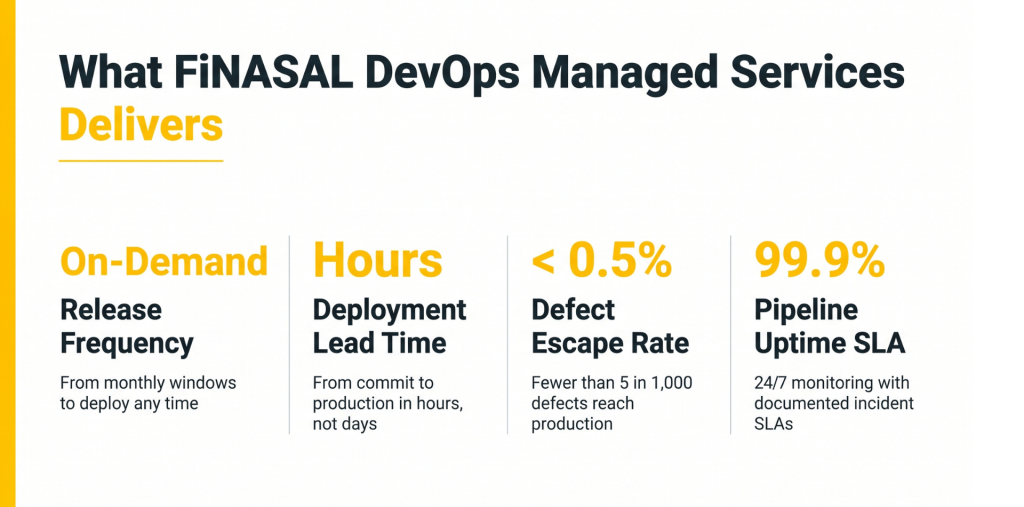
What FiNASAL DevOps Managed Services Delivers
Across banking and financial services clients, FiNASAL’s DevOps managed service engagements have produced:
- Release frequency moving from monthly or quarterly to weekly or on-demand
- Deployment lead time reducing from days or weeks to hours
- Defect escape rate below 0.5% — fewer than 5 in every 1,000 defects reaching production
- 99.9% pipeline uptime with 24/7 monitoring and documented SLA coverage
- Security posture improvement as SAST and DAST findings surface and resolve continuously rather than accumulating between annual audits
These outcomes compound over time. A pipeline that deploys reliably on demand, with security and compliance validated automatically, is a strategic asset — not just an operational improvement.
The Right Question to Ask Right Now
Ask your software delivery team: “How long would it take to deploy a single, tested change to production today?”
If the answer involves a change request, a maintenance window, a manual deployment, and someone staying late to monitor — your delivery process is the constraint on everything your technology team is trying to build.
That is the starting point for a DevOps Managed Services conversation. FiNASAL offers a complimentary DevOps Assessment for banks and financial institutions — a structured review of your current delivery pipeline, security posture, and compliance gaps, with a prioritised roadmap for what a managed service engagement would address first.
Request your assessment: info@finasal.com
DevOps Managed Services: www.finasal.com/services/devops